
Know exactly where you are
Listening, Speaking and Reading tracked separately
One bar per skill
Most apps give you one level. However, if you are a heritage speaker for example, you might follow a whole conversation and not read a menu. Each skill has its own level, and every exercise is adapted to that.
Watch
Watch what you already watch
| Title | Fit | Listening | Pace |
|---|---|---|---|
| 家有儿女 S1E2 | Just right | 92% | Fast |
| 家有儿女 S1E1 | Just right | 91% | Natural |
| Grocery Shopping | Just right | 96% | Slow |
| What Should I Eat? | Easy | 98% | Slow |
| 家有儿女 S1E3 | Stretch | 89% | Fast |
| Chengdu Travels | Stretch | 88% | Fast |
| San Francisco | Hard | 79% | Fast |
Easy97%+Just right90–97%Stretch80–90%Hardunder 80%Listening = how much of it you already understand by ear
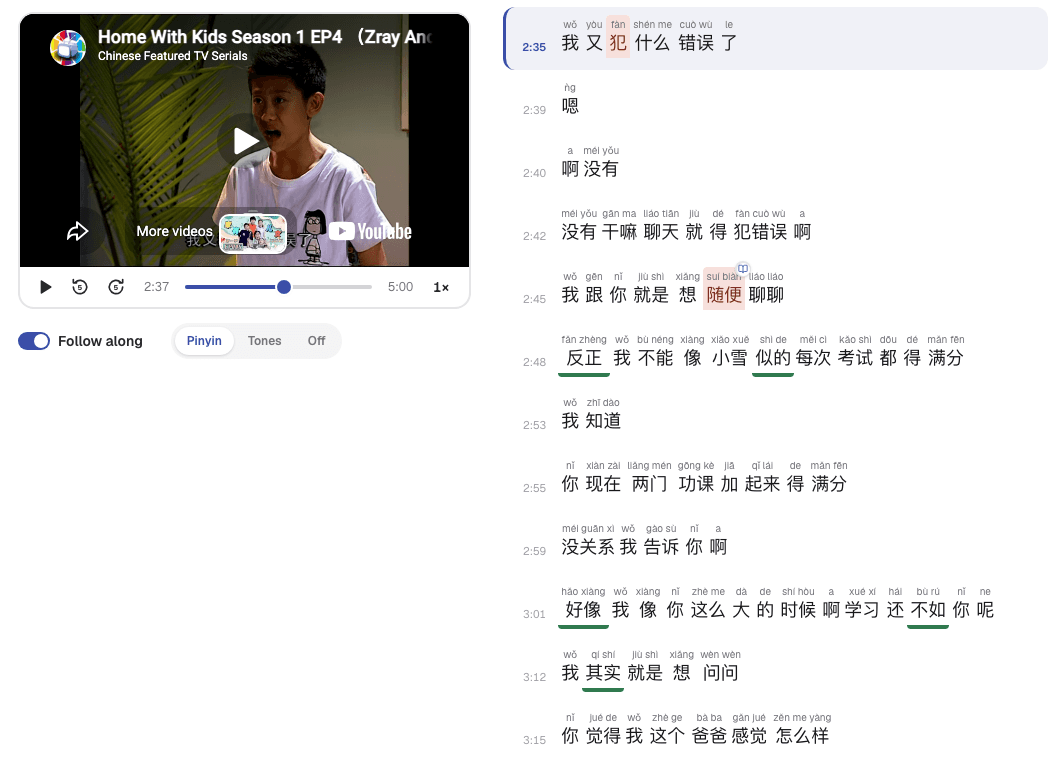
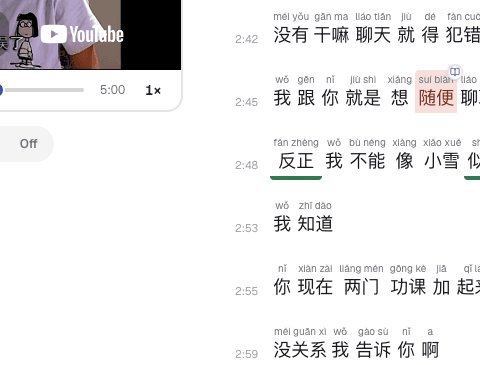
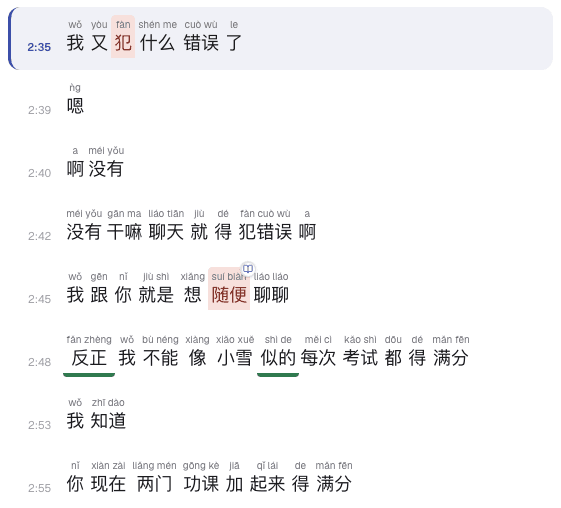
Paste any YouTube link and we transcribe it, with pinyin and a gloss over every word. Each video shows how much of it you already understand by ear, so you can sort by fit: Just right to learn from, Stretch to challenge yourself, Hard for later. Tap any word you don’t know to save it.
Videos play from YouTube in YouTube’s own player, and we only let you import ones whose creators have embedding sharing turned on. If you’re a creator and want to keep general embedding sharing on, but still prefer your videos not to show up here, please reach out and we’ll take them down!
Speak
Use new words in a real conversation
Your challenge 妈妈 will steer towards these
Grammar
把 + object + V bǎ
do something to a thing, and finish it
我把碗洗了。
Words
饭做好了,快来吃吧!今天做了红烧肉。
知道了,我马上来了
快来啊!冷了不好吃
来了来了!哇,味道好香啊!
Talk to a conversation partner about ordering food, getting directions, and more. Turn on a challenge and you get one grammar pattern and two words just past what you can say now. The partner steers toward them and your words stay in the conversation. Words you saved from videos come back here, so what you watch turns into what you say.
How we differ from Duolingo
Our Method: Comprehensible Input
Learn one step at a time. Every new word we recommend is just past where you are (i+1) so you get a little better each time. This is built off linguist Stephen Krashen’s Comprehensible Input theory. Your flashcards are scheduled with Piotr Wozniak’s spaced repetition SM-2 method.
- i+1 Listening/Reading (Input)Watch Fun Videos with Smart Transcripts
- i+1 Vocab (Spaced Repetition)Build Vocab from Videos
- i+1 Speaking (Output)Use Vocab in AI Roleplaying
- i = i+1 ↑ (Growth)Review Newly Retained Content
- Then around again from your slightly higher level
Dictionary data from CC-CEDICT (MDBG, CC BY-SA 4.0). Transcription by SenseVoice from FunASR (Alibaba). HSK word lists after the Ministry of Education’s HSK 3.0 standard; not affiliated with or endorsed by the HSK or its organisers.